
SportsFit Health & Rehab: Sydney Sports Physio Clinic

Updated: Jul 31
What SportsFit actually is
If you've searched "SportsFit", you've likely seen the name on a jersey, a sideline shirt or a club newsletter. SportsFit Health & Rehab is a sports physiotherapy practice with clinics in Five Dock and Gladesville, in Sydney's Inner West and Lower North Shore. We work with athletes across AFL, rugby league, cricket, volleyball and general recreational sport — as well as plenty of people who don't play sport at all but want their body assessed by someone who thinks in terms of load, movement and getting back to activity.
A large part of what we do happens outside the treatment room. We hold club sponsorships, provide sideline and training coverage during the season, and run pre-season screening. That involvement is the reason the name turns up on grounds around Sydney.
Where to find us
Five Dock — 164 Great North Road, Five Dock NSW 2046
Gladesville — 256 Victoria Road, Gladesville NSW 2111
Both clinics run appointment-based physiotherapy consultations, and both are used for in-season injury reviews and rehabilitation programming for the clubs we work with.
Clubs we currently support
Our sponsorships are working relationships, not logo placements. Each one is shaped around the demands of the sport:
Macquarie University AFL Club (Sydney AFL) — AFL is a running-dominant, change-of-direction sport, so our support here leans heavily on hamstring and groin management, running load, and in-season injury review between rounds.
Sydney University Rugby League Football Club (SURLFC) — Contact sport brings a different injury profile: shoulders, knees, ankles, and head knocks that need structured management. We work with players through rehabilitation and graded return-to-play planning alongside club staff.
Sydney Cricket Club (NSW Premier Cricket) — Cricket is a long season with repetitive, one-sided loading. Bowlers in particular need attention on overhead capacity, lumbar tolerance and workload progression. Our involvement spans pre-season conditioning support through to in-season niggle management.
Where our physiotherapists have worked
Our clinicians have worked in a range of sporting environments outside the clinic, including:
Glebe Dirty Reds — rugby league, athlete preparation and rehabilitation
Manly Sea Eagles (NRL) — treatment and performance support within an NRL programme
Canterbury-Bankstown Bulldogs (NRL) — rugby league medical and rehabilitation support
World ParaVolley Sitting Volleyball World Cup 2025 (Indiana, USA) — support for athletes competing internationally in sitting volleyball
That background matters mainly for how we assess. Working in a team environment teaches you to ask specific questions: what does this athlete need to do next week, what does the training week look like, what has to be true before they play again. We bring the same line of questioning to a Sunday-league footballer or a runner training for a half marathon.
What happens in an appointment
A first sports physiotherapy appointment usually runs 40–60 minutes and follows a fairly consistent shape:
History — how the injury happened, the mechanism, what aggravates and eases it, your training or playing load in the weeks before, previous injuries on that side, and what you're aiming to get back to.
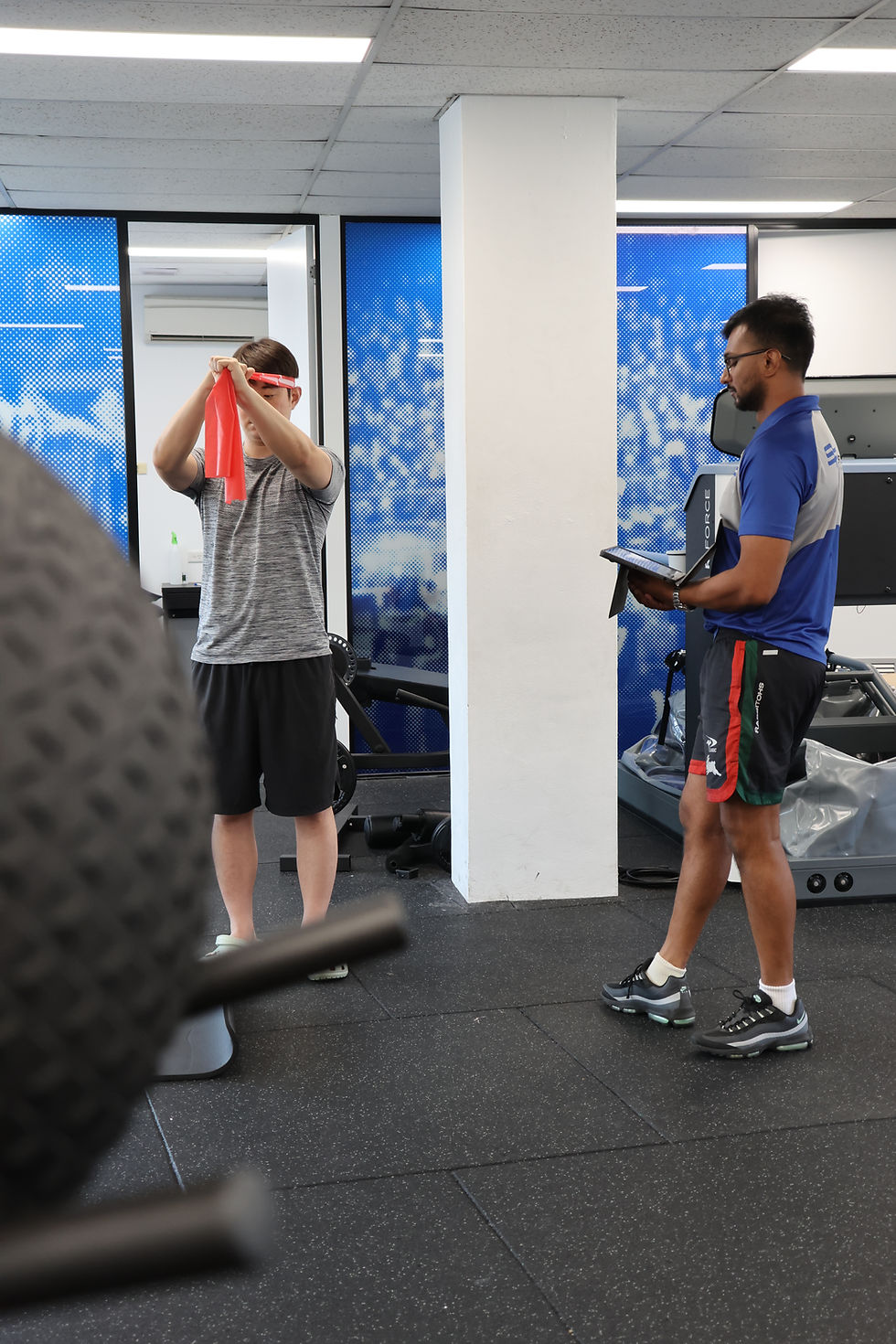
Physical assessment — movement screening, joint range, strength and capacity testing relevant to the area, and specific tests to help build a working diagnosis. For lower limb injuries this often includes single-leg loading and hop or jump testing where appropriate.
Explanation — what we think is going on, what's uncertain, and what would change the plan.
Initial treatment — this may include hands-on techniques, dry needling, taping or bracing where indicated, and early exercise.
A plan — the exercises you'll do, how often, what to load and what to avoid for now, and when we'll reassess.
We don't treat exercise prescription as an afterthought. For most sporting injuries, the rehabilitation programme is the main intervention and hands-on treatment is there to make the loading work more tolerable.
On-field and sideline work
During the season, our physiotherapists attend training sessions and matches for the clubs we support. Sideline work involves acute injury assessment, immediate management decisions, strapping and preparation before play, and communication with coaches and club medical staff about whether a player continues.
That coverage feeds back into the clinic. A player assessed on the field on Saturday is often reviewed at Five Dock or Gladesville early the following week, with the same clinician who saw the injury happen.
Who we see
We see a wide range of people, not only club athletes:
Grassroots and university club players across contact and field sports
Runners, cyclists, swimmers and triathletes managing overuse problems
Gym-based lifters with shoulder, hip, knee or back complaints
Adolescent athletes managing growth-related pain and multi-sport loads
Para athletes and adaptive sport participants
People returning to activity after surgery, or after a long time away from training
What recovery tends to look like
Timeframes vary considerably between individuals, injuries and the demands of the sport being returned to, so we don't put a number on it at a first visit. What we can do is be clear about the stages: settle irritability, restore range and basic strength, rebuild capacity under load, reintroduce sport-specific tasks such as running, cutting, bowling or contact, then progress to full training before returning to competition.
Progress is measured against criteria rather than the calendar — strength compared with the other side, tolerance to running volume, confidence in change of direction. Some injuries move faster than expected, others plateau and need the plan reconsidered. Both are normal, and both are easier to manage when the milestones are agreed early.
When it's worth getting assessed
Consider an assessment if you have an injury that hasn't improved over one to two weeks, pain that changes how you move or run, swelling that keeps returning after training, a joint that gives way or locks, recurring problems in the same area each season, or a head knock sustained in sport. Sooner is generally more useful than later, mainly because early advice on what to load and what to modify shapes the following few weeks.
If you're part of a local club, university team or sporting organisation looking at physiotherapy support arrangements, that's a conversation we have regularly and are happy to have again.
If you would like it assessed, you can book a free injury assessment.

Comments