
Runner's Knee Treatment in Five Dock: A Physio Guide


What people mean by runner's knee
Runner's knee usually describes patellofemoral pain: an ache around or behind the kneecap that builds during running, stairs, squatting or long periods sitting with the knee bent. It rarely arrives as a single dramatic moment. Most people who come into our Five Dock clinic describe a niggle that showed up at the 6km mark, then at 4km, then on the walk back up from the Bay Run car park.
The pain is often hard to point to. Ask someone to show you where it hurts and they'll cup the front of the knee rather than press one spot. It can be worse running downhill, worse on cambered footpaths, and worse the day after a long session rather than during it.
The term covers a few different things. Pain at the lower pole of the kneecap that's sharp with jumping and sled work is more likely patellar tendinopathy. Pain on the outside of the knee that switches on at a predictable distance and switches off when you stop points more toward lateral knee irritation. These are managed differently, which is why guessing from a blog post has limits.
Why it shows up
The kneecap runs in a groove at the end of the femur. Load through that joint rises steeply with knee flexion angle, so deep squats, stairs, hills and a heel-strike running pattern with a collapsed knee all push the numbers up. Pain tends to appear when the load going through that joint outpaces what the surrounding tissue has been prepared for.
Common triggers we see:
A training jump. Adding a parkrun to a three-run week, or moving from flat loops to hill repeats around Russell Lea.
Returning after a layoff and picking up at the volume you finished on.
Low hip and quad strength capacity relative to running volume, particularly single-leg control.
Limited ankle dorsiflexion, which pushes more flexion demand up to the knee.
Footwear changes, especially a sudden drop in heel height.
Running the same direction on the same cambered surface every session.
Weak glutes get blamed for most of this, and hip strength does matter, but quadriceps capacity and total running load are usually the bigger levers.
What assessment looks like
A first appointment runs about an hour, one-to-one, no double-booking. We start with the history, because the pattern of when the knee hurts narrows the diagnosis faster than any single test. How far in does it start? Does it settle within the run or build? What changed in the four weeks before it appeared?
Then we look at how the knee behaves under load. That means watching you squat, step down from a box, hop and run, and comparing left to right. We check knee and hip range, ankle dorsiflexion, patella mobility and tenderness, and we rule out the things that masquerade as runner's knee, including meniscal irritation and referred pain from the hip or lumbar spine.
At Five Dock we also use objective strength testing rather than relying on a manual muscle test. The VALD ForceFrame gives repeatable numbers for hip abduction, adduction and knee extension, and AxIT force plates measure how much force each leg actually produces in a squat or a jump. A 20% side-to-side deficit is obvious on a readout and nearly invisible to the eye. Those numbers also become the benchmark we retest against later, so progress is measured rather than estimated.
How rehab is usually structured
The first job is settling the knee down without stopping everything. Complete rest tends to deload the tissue you need to build, and most runners hate it anyway. More often we adjust volume, flatten the hill work, change the surface, and sometimes shift cadence slightly, which reduces peak patellofemoral load at a given pace.
Alongside that, strength work targets the quadriceps through ranges the knee tolerates, then progressively into deeper flexion. Hip and calf capacity get built in the same block. Hands-on treatment can help with symptom relief in the short term, and we use it as part of the plan rather than the plan itself.
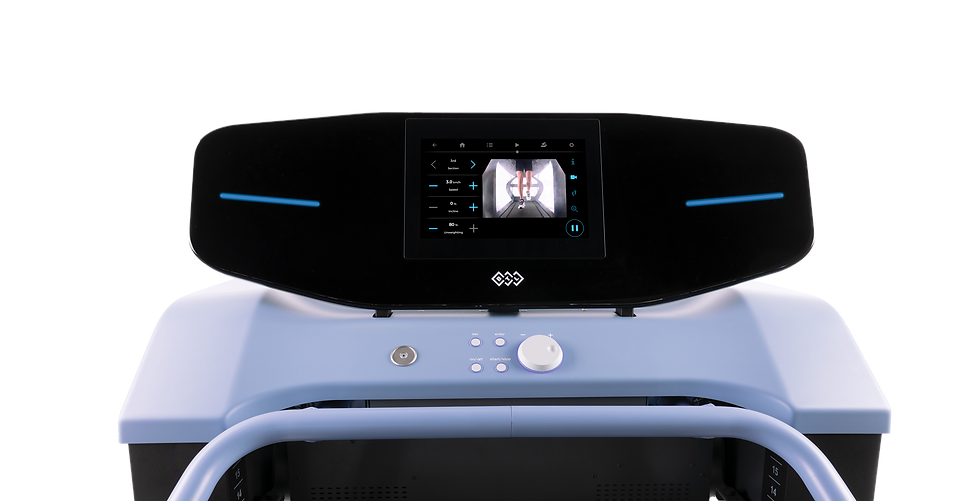
For people who need to keep running while the knee builds capacity, the anti-gravity treadmill at Five Dock lets us set bodyweight to a percentage, so a runner can hold technique and aerobic fitness at a reduced load and step that percentage up over weeks. It was one of the first installed in Australia and it earns its keep most with runners coming back from a load-related knee problem.
Return to full running is staged. We generally build frequency first, then duration, then intensity and hills, retesting strength numbers along the way. Patellofemoral pain often responds over a number of weeks, though the timeframe varies a lot with how long it's been there and what the training week looks like.
When to get it looked at
Get the knee assessed if pain has lasted more than two or three weeks, if it's limiting stairs or sitting as well as running, or if you've already tried backing off and it returns at the same point every time. Swelling, locking, giving way or pain after a specific twisting incident need to be checked sooner, because they suggest something other than a load problem.
If your knee has been doing this for a season, book an assessment and get an actual diagnosis and a plan built around your running week.
Read more about our knee services.
We go deeper on knee at sydneyaclphysio.au.
If you would like it assessed at our Five Dock clinic, you can book a free injury assessment.

Comments