
Quad Tears: A Proper Guide to Diagnosis, Rehab, and Getting Back to Sport

Updated: Jul 30
In this article
What is a quad tear?
Grades explained
How it happens
Symptoms to watch for
How we assess it
Treatment at SportsFit
Recovery timelines
Book an appointment
The quadriceps are the most powerful muscle group in the lower limb. They absorb force every time you land, decelerate, or change direction — and they drive every kick, sprint, and jump you produce. When they tear, you know about it. The sensation is usually immediate and significant — a sharp pain at the front of the thigh that stops the activity cold.
Quadriceps injuries range from a minor muscle strain that resolves in a couple of weeks to a significant partial or complete tear that requires careful, staged rehabilitation over several months. They're common in field sport athletes, AFL players, and football players across the Inner West — and they have a frustrating tendency to recur if the rehab isn't done properly.
At SportsFit Health & Rehab in Five Dock and Gladesville, we treat quad injuries across the full spectrum of severity. This guide covers what you actually need to know.
What is a quad tear?
The quadriceps is a group of four muscles — hence "quad" — running along the front of the thigh. All four converge into the quadriceps tendon, which connects to the patella (kneecap) and then continues as the patellar tendon down to the shin. The four muscles are:
Rectus femoris
The only quad muscle that crosses the hip joint as well as the knee — it both flexes the hip and extends the knee. This dual-joint function makes it uniquely vulnerable to injury, particularly during explosive hip flexion combined with knee loading. It's by far the most commonly strained of the four, and most quad tears we see are rectus femoris injuries.
Vastus lateralis
The largest of the four, running along the outside of the thigh. Injuries here are less common than rectus femoris but do occur with high-load eccentric movements. The VL contributes significantly to lateral patellar tracking, which means injuries can sometimes be associated with patellofemoral symptoms during rehab.
Vastus medialis
Runs along the inner thigh and inserts particularly low on the patella — the "teardrop" shape visible on the inner knee. The VMO (vastus medialis oblique) portion is critical for terminal knee extension and patellar stability. Isolated VM injuries are uncommon but VM weakness is a significant factor in patellofemoral dysfunction during quad rehabilitation.
Vastus intermedius
The deepest of the four, lying directly on the femur. Difficult to palpate and isolate clinically. Injuries in isolation are rare — it tends to be involved in higher-grade, more complex quad injuries rather than as a standalone presentation.
Tears can occur in the muscle belly itself, at the musculotendinous junction (the most common site for significant strains), or at the tendon-bone interface (the proximal attachment on the anterior inferior iliac spine for rectus femoris, or the distal attachment at the patella — the latter being a quad tendon rupture, a distinct and serious injury).
Quad tear vs. quad tendon rupture: These are different injuries requiring different management. A quad muscle tear involves the muscle fibres themselves. A quad tendon rupture involves the tendon connecting the muscle to the kneecap — these are typically seen in older athletes (40s–60s), often with a history of tendinopathy, and may require surgical repair. If you can't straighten your knee against gravity after a forceful injury at the front of the thigh above the kneecap, that warrants urgent assessment.
Grading the injury
Grade 1 — Mild strain — minor fibre disruption
Tightness and mild pain in the front of the thigh, often without immediate cessation of activity. The athlete may finish the game or training session before the stiffness sets in. Pain with resisted knee extension but preserved strength. Recovery 1–2 weeks with good management.
Grade 2 — Partial tear — moderate to significant fibre disruption
Sudden, clear pain that stops the activity. Walking may be painful, particularly stair descent or pushing off. Bruising tracking down toward the knee over 24–48 hours. Weakness on resisted knee extension. This is the most common quad injury presentation we see at our Five Dock and Gladesville clinics. Recovery 3–8 weeks depending on location and severity.
Grade 3 — Complete rupture
Complete loss of continuity of the muscle or tendon. Immediate inability to extend the knee against gravity. Significant swelling and a palpable defect. Surgical review is required for complete quadriceps tendon ruptures. Muscle belly complete tears may be managed conservatively but require specialist input. Recovery 4–6+ months.
A particular subset worth knowing about is the proximal rectus femoris avulsion — where the muscle tears off its attachment at the anterior inferior iliac spine (ASIS). This can present like a standard quad strain but involves a bone attachment and often requires imaging to characterise properly. Common in young kicking athletes and sprinters.
How does it happen?
Explosive kicking
The single most common mechanism for rectus femoris injury. At the moment of ball contact, the quad is generating maximal force while also being rapidly lengthened as the hip extends and knee bends behind the kicking leg. AFL and football players are at particular risk, especially with maximal effort shots at goal or long clearing kicks. We see a steady stream of these through the winter season from Inner West clubs.
Sprinting and acceleration
During maximum-speed sprinting, the quad is required to produce very high eccentric force during the late swing phase — decelerating hip flexion before the foot strikes the ground. This is the same mechanism as hamstring tears. Fatigue, inadequate warm-up, or a rapid increase in sprint volume all increase risk.
Sudden deceleration and landing
Absorbing a hard landing from a jump, stopping suddenly from full speed, or being tackled while weight-bearing through a flexed knee all create high eccentric quad demand. In athletes with existing quad fatigue or previous injury, the margin for error is smaller.
Direct contusion ("corky")
A direct blow to the front of the thigh — a knee, elbow, or hard contact in a contact sport — causes a muscle contusion (bruising) rather than a tear, but the clinical presentation and management overlaps. Cork injuries need proper management to avoid myositis ossificans (bone formation within the muscle) if they're severe.
Symptoms and what to look for
At the time of injury:
Sudden pain at the front of the thigh — typically mid-thigh or at the hip attachment for rectus femoris
A "giving way" feeling in the leg
Immediate reduction in sprinting, kicking, or jumping capacity
In higher-grade injuries, immediate inability to continue
In the hours and days after:
Bruising tracking down the front and sides of the thigh (24–72 hours)
Swelling and warmth over the injury site
Pain bending the knee — particularly trying to achieve full knee flexion (e.g. sitting cross-legged)
Pain descending stairs or squatting
A palpable lump or tender area within the muscle belly
Signs warranting urgent assessment:
Inability to straighten the knee against gravity — possible quad tendon rupture requiring surgical assessment
Significant swelling above the kneecap with a palpable gap — same concern
Severe direct contusion with very firm, tense swelling — risk of compartment syndrome in significant cases
History of steroid use (local or systemic) combined with quad injury — higher risk of tendon rupture
How we assess it at SportsFit
Our quad injury assessment at Five Dock or Gladesville covers:
Mechanism and timing — kicking mechanism vs. contusion vs. deceleration tells us a lot about what structure is involved and where
Palpation — identifying the injury site (proximal, mid-belly, or musculotendinous junction), the degree of local tenderness, and whether a defect is palpable
Knee flexion range — passive knee flexion in prone is one of the most useful early measures of severity. We benchmark this and track it through recovery
Resisted knee extension strength — assessed in multiple positions, particularly isolating rectus femoris from the vasti
Functional testing — single leg squat, step down, and hop tests as appropriate to the presentation and timing
Assessment for myositis ossificans risk — in contusion injuries, a very firm, warm haematoma that isn't resolving appropriately flags for monitoring
Ultrasound is useful for characterising the injury in grade 2 and above, and particularly helpful for clarifying musculotendinous junction vs. proximal attachment injuries. We'll refer for imaging where it changes management — particularly for proximal avulsion injuries in young athletes and for any presentation where a tendon rupture is in the differential.
For patients who've had a quad injury in the context of a previous ACL reconstruction or knee surgery, we take extra care with the assessment — the quad is often already in a reduced state, and a new injury on that background needs careful management. We have extensive experience with this population through our ACL rehabilitation programs at SportsFit.
Treatment: what proper quad rehab looks like
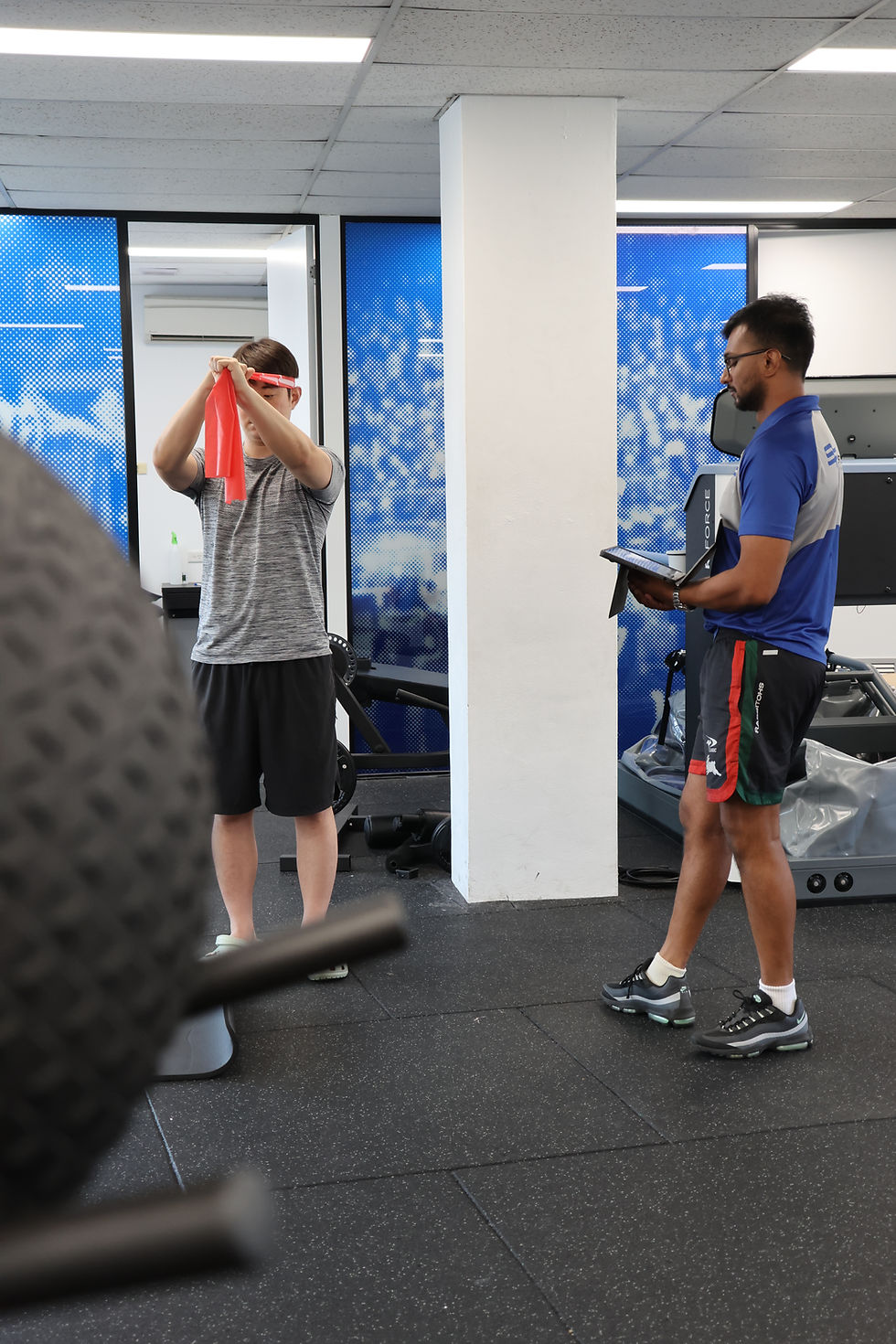
The principles are similar to other muscle injuries — progressive loading, milestone-based progression, and no shortcuts on the return-to-sport criteria. The specific challenge with quad injuries is that the muscle is involved in almost every lower limb movement, so managing load in the early stages requires some creativity.
Stage 1: Early management (days 0–5)
Ice and compression in the first 48 hours to limit haematoma formation
For contusion injuries specifically, we use the PRICE approach and avoid aggressive massage or heat in the first 72 hours — this is one of the few cases where early heat can make things worse by expanding the haematoma
Gentle, pain-free knee flexion range of motion from day one — we don't immobilise. Movement drives healing
Isometric quad contractions (pressing the knee flat, activating the quad without movement) begin very early and are excellent for maintaining neuromuscular activation without stressing the healing tissue
Pool walking if available — unloaded movement is better than no movement for recovery trajectory
Stage 2: Progressive loading (weeks 1–4)
Isotonic knee extension with progressive load — beginning at pain-free range and gradually increasing both range and resistance
Leg press with controlled range — allows quad loading while controlling the end range knee flexion that stresses the healing tissue
Hip flexor and glute work — unaffected by the quad injury but critical for maintaining overall kinetic chain strength
Soft tissue therapy to manage scar tissue formation and restore tissue extensibility — particularly relevant for musculotendinous junction injuries
Progressive knee flexion stretch once the acute phase has passed — we want full range restored before running begins
Stage 3: Return to running (weeks 3–6)
Before returning to any running, we want to see:
Full passive knee flexion (heel to buttock) without significant pain
Pain-free resisted knee extension at full effort
Single leg squat without pain or significant compensatory movement
Limb symmetry index on strength testing at 80% or above
Return to running follows a walk-jog progression, with straight-line running established before any acceleration, deceleration, or directional change work is introduced.
Stage 4: Kicking and sport-specific return
This is the most important and most frequently rushed stage for kicking sport athletes. The quad is at maximum eccentric load during the kicking action — returning to full-effort kicking before the tissue is genuinely ready is the single biggest driver of quad re-injury.
We build kicking back in progressively: short, low-effort passes → medium-range passes with increasing effort → maximal effort kicks at goal. For AFL players from Inner West clubs and social football players across Five Dock and Gladesville, this phase typically runs 1–2 weeks beyond when the athlete feels "ready" — and it's worth the patience.
Recovery timelines
Grade 1 — Return to light activity: 3–7 days; Return to full sport: 1–2 weeks
Grade 2 — Return to light activity: 1–2 weeks; Return to full sport: 3–8 weeks
Grade 3 / tendon — Return to light activity: 4–8 weeks; Return to full sport: 4–6+ months
Proximal rectus femoris avulsions sit at the longer end of the grade 2 range, often 6–10 weeks to return to kicking sport. Contusion injuries with significant haematoma can also surprise people with their recovery time — a bad cork managed poorly can take 4–6 weeks, whereas one managed well from day one often resolves in 2–3 weeks.
Preventing quad re-injury
Don't rush the kicking return. This cannot be said enough. The eccentric load of maximal kicking is enormous — the tissue needs to be genuinely ready, not just pain-free at rest.
Nordic hamstring and eccentric quad work during your season. Maintaining eccentric strength is the best insurance policy against both initial injury and re-injury.
Manage kicking volume intelligently. High-volume kicking sessions on top of heavy match loads, or returning from a break and going straight into maximal kicking, is a reliable recipe for a proximal rectus femoris strain.
Warm up properly before maximal kicking. The rectus femoris in particular needs progressive loading before full-effort kicks — especially on cold mornings.
Address the previous injury properly. Quad re-injury rates are high in athletes who don't complete their rehabilitation. Scar tissue has different mechanical properties, and an undertreated grade 2 becomes the site of the next grade 2.
Quad injury stopping you from training or playing?
Whether it happened during a match at Henley Oval, a training session in Five Dock, or on the fields around Gladesville — our team at SportsFit can assess it promptly and get a structured rehab program underway. We work regularly with AFL, football, and cricket athletes across the Inner West and Northern Sydney.
Five Dock (Flagship) — Great North Road, Five Dock NSW
Gladesville — Gladesville NSW
**Same-day appointments available for acute injuries. Book online or call us directly.**

Comments