
Clinical Pilates in Gladesville: What to Expect

Updated: Jul 26
Clinical Pilates in Gladesville, physiotherapist-led
If you're searching for Pilates in Gladesville and you're carrying a niggling low back, a hip that grumbles after long runs, or a shoulder that's still not right six weeks after a fall, a general studio class and a physiotherapist-led clinical Pilates session are two quite different things. Both have a place. This page explains what clinical Pilates at SportsFit Gladesville actually involves, who it tends to suit, and what a first appointment looks like — so you can decide whether it's the right fit before you book anything.
What clinical Pilates is (and isn't)
Clinical Pilates uses the same equipment and much of the same movement vocabulary as studio Pilates — reformer, mat, springs, straps, boxes — but the programming is built around an individual assessment rather than a class plan.
The practical differences:
It's run by a physiotherapist. Your instructor has assessed your movement, knows your injury history, and can modify or remove an exercise based on clinical reasoning rather than a general regression.
Group sizes are small. Sessions are typically capped so each person can be working on a different program at the same time.
The program changes as you change. Load, range and complexity are progressed deliberately, and revisited if symptoms flare.
It can sit alongside other treatment. For many people, Pilates is the exercise-loading arm of a broader rehab plan that also includes hands-on treatment, gym-based strength work or a running program.
What it isn't: a substitute for a proper diagnosis, or a guaranteed route out of a problem. It's one approach among several, and a physiotherapist should be able to tell you why they think it suits your presentation.
Who it tends to suit
People who come to clinical Pilates in Gladesville commonly fall into a few groups:
Persistent or recurrent low back pain. Particularly people who've had several episodes over the years and want to build tolerance to bending, lifting and sitting rather than just settle the current flare.
Post-injury rehab that has plateaued. Ankle, knee, hip or shoulder injuries where the acute pain has settled but strength, control or confidence hasn't fully returned.
Neck and upper back symptoms in desk-based workers. Where load tolerance through the shoulder girdle and thoracic mobility are worth addressing directly.
Pregnancy and postnatal. Modified programming through pregnancy, and a graded return to loading afterwards, including work through the pelvic floor and abdominal wall.
Athletes in the off-season or in-season. Rowers, cricketers, runners, netballers and cyclists often use reformer work for single-leg control, rotational strength and hip and thoracic mobility that's hard to target with barbells alone.
People who want supervised strength work but find the gym unappealing. That's a legitimate reason. Adherence matters more than the perfect program.
What happens at the initial assessment
Everyone starts with a one-on-one initial assessment before joining a class. It typically runs 45–60 minutes and covers:
History. What's going on, how long for, what aggravates and eases it, previous injuries, surgeries, imaging, training load and what you're actually trying to get back to — whether that's a half marathon, lifting a toddler, or sitting through a workday.
Physical assessment. Posture and movement screening, joint range, muscle strength and length testing, and specific orthopaedic tests where relevant. For lower limb presentations this usually includes single-leg control tasks — squat, hop, balance — because reformer work will load those patterns.
Equipment familiarisation. Getting you onto the reformer, working out starting spring settings, and checking how you respond to a handful of foundation exercises.
A written program. You leave with a starting program that the physio has recorded, so any instructor supervising your class knows what you're doing and why.
Bring or wear clothing you can move in, and grip socks if you have them. Bring any relevant scan reports or specialist letters.
What a class involves
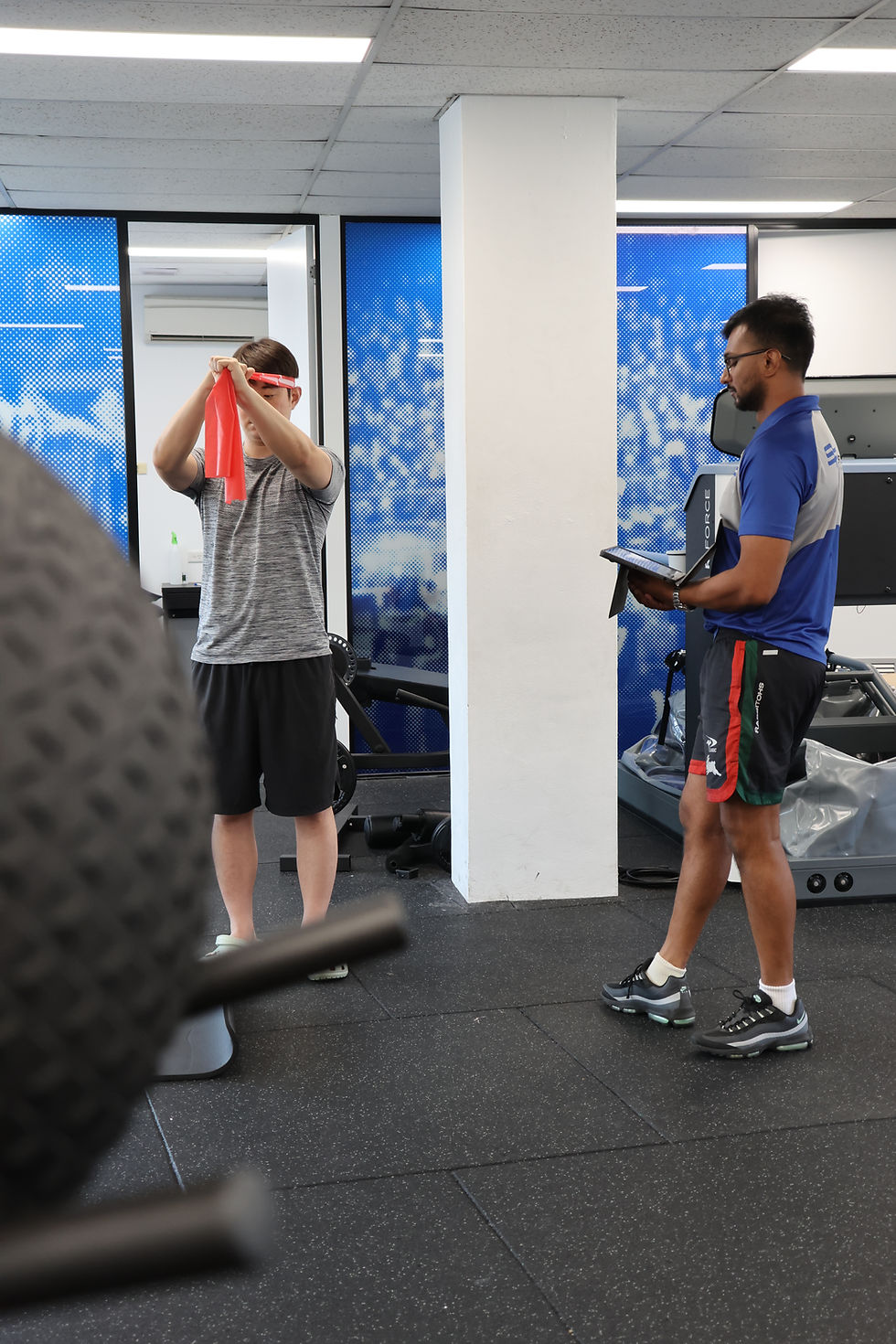
Small-group sessions generally run around 45–50 minutes. You'll work through your individual program, usually across the reformer plus mat, trapeze table or small equipment such as bands, weights and balls, depending on what you need.
A typical session structure: a mobility and activation warm-up, a block of primary strength or control work targeting your key areas, accessory work, then something more integrated — a standing, loaded or sport-specific pattern. The physio supervising circulates constantly, cueing technique and adjusting springs.
Mat Pilates classes are also available and are useful if you want something you can replicate at home, or if reformer access isn't practical for your schedule.
How often, and for how long
Most people attend once or twice a week. Once weekly is enough to learn and progress a program; twice weekly tends to build strength more quickly if the schedule allows.
Realistically, changes in strength and movement control take time. Many people notice differences in how they move and how confident they feel within the first few weeks, while meaningful strength adaptation is generally a matter of months, not sessions. Programs are usually reviewed every 6–10 sessions to reassess and progress. Some people transition to independent gym work after a block; others keep Pilates as ongoing maintenance. Both are reasonable.
When to see a physiotherapist first
If your symptoms are new, severe, worsening, or associated with pins and needles, numbness, weakness, or unexplained loss of bladder or bowel control, book a standard physiotherapy assessment rather than jumping into a class. The same applies to a sudden acute injury — a rolled ankle or a pulled hamstring needs assessing before you load it in a group setting.
Rebates and practicalities
Because sessions are delivered by a registered physiotherapist, clinical Pilates at SportsFit Gladesville may be claimable under the physiotherapy extras component of private health insurance. Rebate amounts vary considerably between funds and policies, and annual limits reset each calendar year, so it's worth checking your specific cover with your fund. We can provide item numbers on request.
Our Gladesville team
Clinical Pilates sessions are led by Jonita Zhou, a physiotherapist who completed her Master of Physiotherapy in 2021 and has several years of combined clinical and Pilates teaching experience. Her focus is on movement assessment, injury rehabilitation and individualised exercise programming, with sessions structured around each person's presentation and goals.
If you're not sure whether clinical Pilates or standard physiotherapy is the better starting point, an initial assessment is designed to answer exactly that question.
If you would like it assessed, you can book a free injury assessment.

nice text bro
I observe the analytical neutrality applied to concluding remarks. Interpretations remain cautious. Additional contextual insight on this matter may be found on the website . Digital entertainment environments contextualize participation variability.