
Ankle Sprain Treatment in Five Dock: A Physio Guide


What actually happens when you roll an ankle
Most ankle sprains happen the same way. The foot rolls inward under a loaded leg, usually when you land on someone's foot, change direction on a worn patch of grass, or step off a kerb without looking. The ligaments on the outside of the ankle take the strain. The anterior talofibular ligament (ATFL) is the one that gives way first, and it is involved in the large majority of lateral sprains. If the force keeps going, the calcaneofibular ligament (CFL) can be involved too.
Grading is a rough guide rather than a precise science. A Grade I sprain involves stretching of the ligament with mild swelling and little loss of stability. Grade II involves partial tearing, more bruising, and noticeable difficulty weight-bearing. Grade III is a complete tear, often with significant swelling and a feeling that the ankle is not holding you.
Two other injuries get mislabelled as "just a sprain". A high ankle (syndesmosis) sprain happens with a forced outward twist, common in rugby and football when a player is tackled with the foot planted. Pain sits above the ankle joint line and squeezing the calf reproduces it. These behave differently and typically take longer than a lateral sprain. The second is a fracture of the fifth metatarsal or the fibula, which can feel similar in the first hour.
When to get it looked at
Get assessed if you could not take four steps immediately after the injury, if there is bone tenderness along the back edge of either ankle bone, or if swelling comes on fast and hard. Those points come from the Ottawa Ankle Rules, a screening tool used to decide who needs an X-ray, and they are part of the first-visit assessment at our Five Dock clinic.
Also worth assessing: any ankle that is still swollen or stiff three weeks after the injury, and any ankle that has now rolled more than twice. Repeat sprains are the strongest predictor of the next one.
What assessment involves
The first session starts with how the injury happened, because the mechanism narrows the diagnosis quickly. Rolling in under load points to the lateral ligaments. A twist with the foot fixed points higher. Landing from a jump with a crunch points somewhere else again.
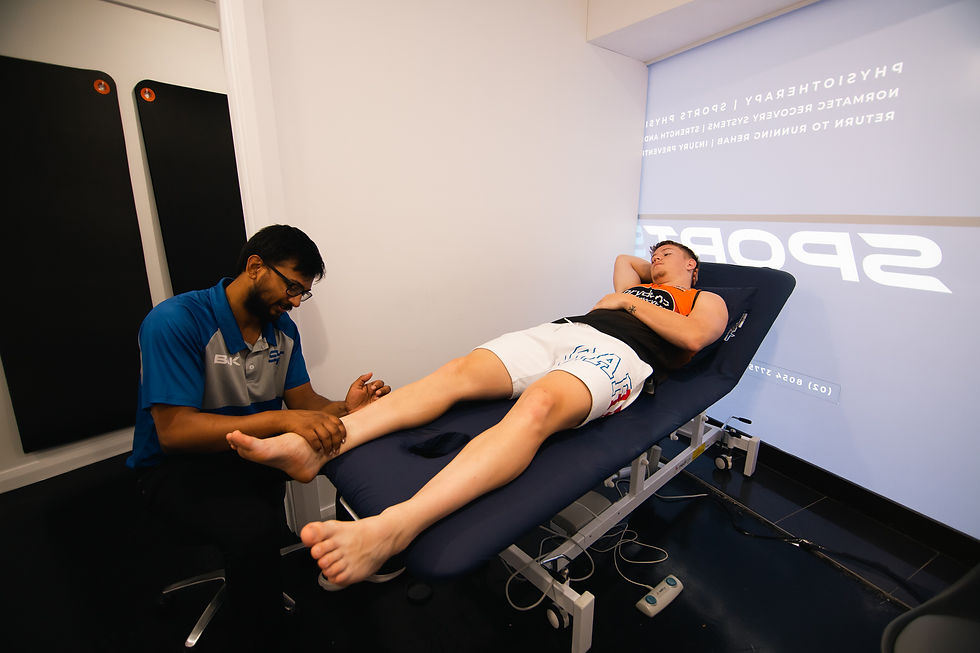
From there, the physiotherapist works through palpation of the ligaments, the base of the fifth metatarsal, the fibula and the syndesmosis; range of motion in both directions, with a weight-bearing lunge test to measure how far the knee travels over the toes compared with the other side; and stability testing including the anterior drawer and talar tilt. Single-leg balance, calf raise capacity and hopping get tested once they are tolerable.
At Five Dock we also use AxIT force plates and the VALD ForceFrame for objective numbers. Calf strength, single-leg jump height, landing symmetry and hop distance all give a measurable comparison against the uninjured side, which matters more later when you want to know whether the ankle is ready for training rather than just walking.
What treatment looks like
Early on, the aim is to settle swelling and get you weight-bearing and moving in a controlled way. That can involve compression, taping or a brace, graded range of motion work, and manual therapy at the talocrural and subtalar joints to restore dorsiflexion, which is often the first thing lost and the last thing regained.
The middle phase is strength and balance. Calf raises through full range, seated and standing to load both gastrocnemius and soleus. Peroneal work for the muscles running down the outside of the ankle. Single-leg balance progressed from stable to unstable to reactive, because the ankle's position sense takes a hit after a sprain and it does not restore itself on its own.
The final phase is load and direction. Hopping, landing, deceleration, cutting off both legs, then sport-specific drills. Our gym space at Five Dock has room for running and change-of-direction work rather than only table-based treatment, and the anti-gravity treadmill can be used to reintroduce running at reduced bodyweight when full loading is still uncomfortable.
Why ankle sprains keep coming back
Most people stop rehab when the ankle stops hurting. Pain settles well before capacity returns. What remains is reduced dorsiflexion, a calf that fatigues earlier than the other side, and slower balance corrections. Put that ankle back into a netball court or a football field and the same mechanism finds the same weakness.
Before returning to sport, reasonable benchmarks include symmetrical dorsiflexion on the lunge test, single-leg calf raise numbers close to the other side, and hop testing within a sensible margin of the uninjured leg. Numbers give you something to argue with instead of a guess.
If your ankle is still swelling after training, giving way on uneven ground, or you are taping it every week out of habit, book an assessment and get it measured properly.
Read more about our ankle services.
If you would like it assessed at our Five Dock clinic, you can book a free injury assessment.

Comments